For chronological order, click here for the previous WW2 post!
Having ruled out a premature landing in Europe, Anglo-American planners reached a compromise and agreed to an amphibious invasion of French North Africa (Operation Torch). In addition to providing the U.S Army some much-needed experience, it was hoped that the landings would draw German forces away from the Soviet Union and trap Axis forces as they retreated from Egypt. The Vichy French government was officially neutral, but expected its 120,000-strong garrison to defend against any invasion. In reality, many Vichy commanders had mixed loyalties; the Allies hoped at the very least that there would be little to no resistance.
As the seat of French colonial power, Algiers was a crucial target. In addition to Torch‘s three main landings, a surprise night attack on the city’s harbour (Operation Terminal) was also planned. Royal Navy destroyer Broke would ram the protective boom and land U.S infantry at the Quai de Dieppe, followed 15 minutes later by the destroyer Malcolm. The plan depended on the Vichy defenders being drawn away by the Allied beach landings, as well as the silencing of coastal artillery by British Army Commandos.
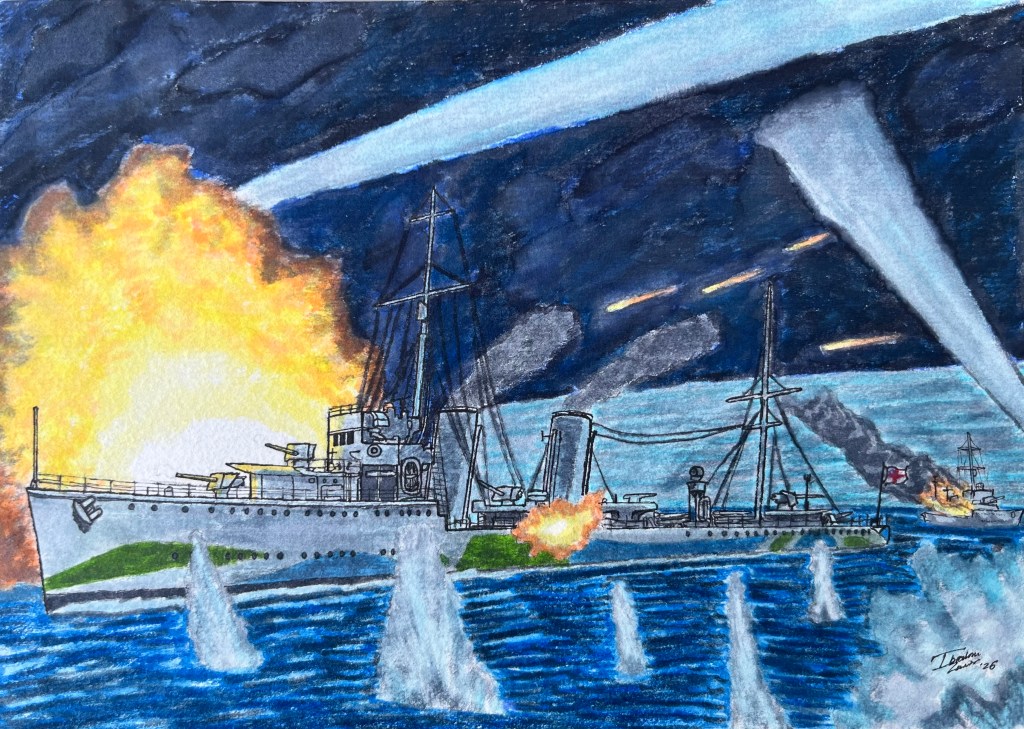
At midnight on 8th Nov, the pro-Allied Resistance launched a coup in Algiers, arresting the commander-in-chief and disrupting Vichy communications. Broke and Malcolm began their assault at 01.40 hrs, carrying 662 American troops from 3rd Battalion, 135th Infantry Regiment under Lt.Colonel Edwin Swenson. Suddenly, the two destroyers were blinded by searchlights and artillery fire. The Commandos had failed to capture the coastal batteries, which were well-positioned on the high bluffs around the harbour and now inflicting heavy damage on the two vessels.
In this picture, Broke – painted in the ‘Western Approaches’ camouflage scheme – pushes through to its objective. In the background, Malcolm can be seen in flames after taking a devastating hit at 04.00 hrs that forced her to retreat.
The destroyers missed the harbour entrance twice, but on her fourth attempt Broke managed to tear through the boom and dock at the Môle Louis Billiard. From 05.30 hrs the U.S infantry disembarked, capturing key port facilities and extending their perimeter. But as the morning continued, Broke was forced out by artillery fire, re-embarking sixty troops before retreating at 09.20 hrs. The rest of Swenson’s troops – low on ammunition and surrounded by Senegalese tirailleurs – surrendered at 12.30hrs.
Terminal had cost 24 dead and 55 wounded; both destroyers had also suffered severe damage, with Broke sinking the next day. But the operation had succeeded in preventing the French from sabotaging the port facilities. With Allied forces enveloping their position, Vichy commanders surrendered Algiers in the evening of Nov 8th. More broadly, Operation Torch had achieved total surprise and encountered little serious opposition, paving the way for a final confrontation with Axis forces in Tunisia.
Sources
Bogdanovic, Nikolai. World War II: Battle by battle. Oxford, England: Osprey Publishing, 2019.
Encyclopedia Brittanica, ‘Operation Torch’, 11th Oct 2026 (https://www.britannica.com/topic/Operation-Torch, accessed 8th Nov 2026).
Herder, Brian Lane. Operation Torch 1942: The invasion of French North Africa. Oxford, England: Osprey Publishing, 2017.
Naval History and Heritage Command, ‘Operation Torch: Invasion of North Africa, 8-16 November 1942’ (https://www.history.navy.mil/browse-by-topic/wars-conflicts-and-operations/world-war-ii/1942/operation-torch.html, accessed 8th Nov 2026).
By Ibrahim Zamir

