For chronological order, click here for the previous WW2 post !
By the end of January 1942, German forces had been pushed back from Moscow and suffered around one million casualties. Eager to retake the initiative, Hitler planned a summer offensive (Operation Blau) targeting oilfields in the southern Caucasus: a pressure point that could re-supply Germany’s depleted fuel stocks and knock the Soviet Union out of the war.
The city of Stalingrad – stretched out 25 miles along the west bank of the Volga River – was planned as a secondary target, but gradually became central to the outcome of Operation Blau. Despite fuel shortages and Soviet counterattacks, Friedrich Paulus’s 6th Army managed to reach the outskirts of the city and link up with 4th Panzer Army on 2nd September.
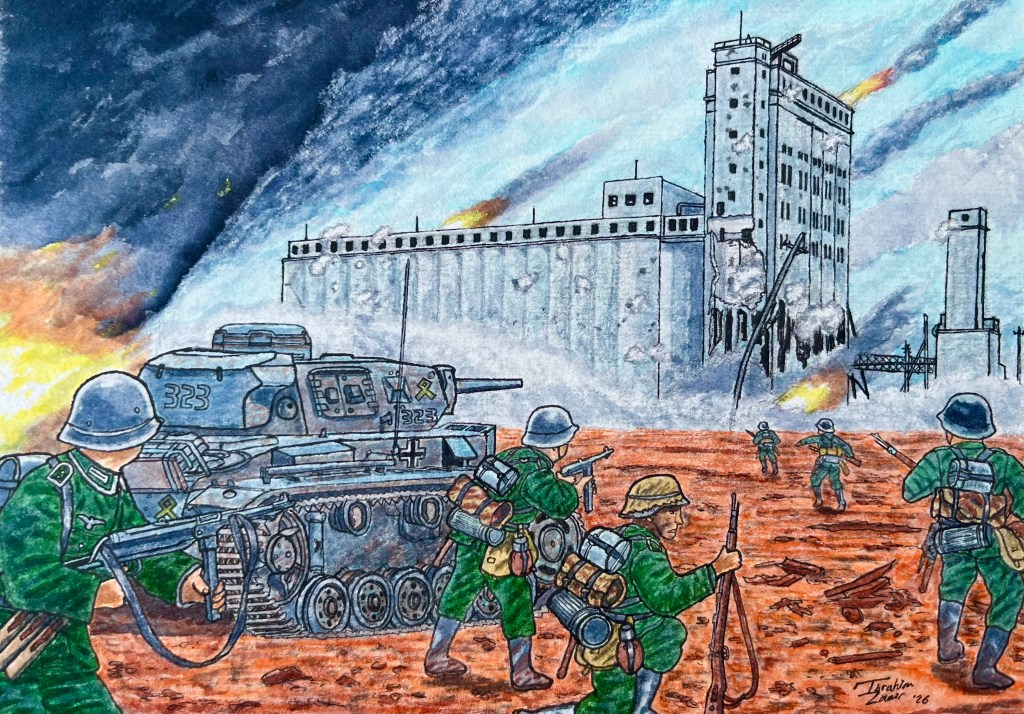
The Germans began their first assault on 14th Sept. While 6th Army pushed towards the city centre, 4th Panzer Army secured the southern flank with a two-pronged attack. The only thing standing in its way was a large grain elevator, defended by 50 Soviet troops from 92nd Naval Infantry Brigade and 35th Guards Rifle Division. Made of reinforced concrete and standing 35 metres tall, the colossal structure was a vital source of food and a key landmark near the banks of the Volga. Three German divisions (14th Panzer, 24th Panzer and 94th Infantry Divisions) were tasked with capturing it.
In this picture, we see the grain elevator under heavy artillery fire while German infantry move up alongside a Panzer III (marked with the yellow runic symbol of 14th Pz. Division). As the standard German medium tank, the Panzer III had seen extensive service by 1942 but was outgunned by Soviet T-34 and KV models. Unlike previous campaigns, the urban environment of Stalingrad severely hampered German tactics, which depended on the close coordination of tanks, infantry, and air power. Armoured vehicles would be vulnerable if they moved without infantry support, and air power would be less accurate overall.
On the evening of 21st Sept, the Germans managed to storm the grain elevator from the north-west side and overwhelm the defenders. Although some Soviet troops managed to escape across the Volga, the fight for the grain elevator – and the first assault on the city at large – was a major success. The Germans controlled the Volga over a five-mile front, as well as most of the city centre. Soviet forces were now confined to the northern factory district, and 6th Army was on the cusp of controlling almost all of Stalingrad.
Sources
Antill, Peter. Stalingrad 1942. Oxford, England: Osprey Publishing, 2007.
Bogdanovic, Nikolai. World War II: Battle by battle. Oxford, England: Osprey Publishing, 2019.
National WWII Museum, ‘Unsung Witnesses of the Battle of Stalingrad’, Sept 9th 2022 (https://www.nationalww2museum.org/war/articles/unsung-witnesses-battle-stalingrad, accessed 27th Sept 2026).
Stalingrad Tours, ‘Stalingrad Grain Elevator Tour: Description’, no date (https://stalingradtours.com/en/tours/articul/vogograd_stalingrad_grain_elevator_tour, accessed 27th Sept 2026).
By Ibrahim Zamir

