For chronological order, click here for the previous WW2 post!
Despite severe losses at the Coral Sea and Midway, Japan continued to expand into the South Pacific in order to consolidate its holdings and push further into the region. From early-July 1942, Japanese forces landed on Guadalcanal – a remote island in the southern Solomons – and began constructing an airfield on its northern coast that could threaten supply lines to Australia and New Zealand. Eager to seize the initiative after Midway, US commanders began planning their first major land offensive of the war.
On 7th August, the 1st Marine Division landed on Guadalcanal, capturing the unfinished airfield the next day with little resistance. Known as ‘Henderson Field’, the Marines quickly got to work completing the runway, hosting the first American aircraft on 20th Aug. Despite a lack of supplies, the Marines began sending out patrols and preparing a thin defensive line on the west bank of the Ilu River (known as the Tenaru).
In the early hours of 21st Aug, the Japanese launched their first attempt to retake the airfield. Colonel Ichiki Kiyoano was confident that his small detachment of 800 men – supported by eight heavy machine guns and two 70mm guns – would push the Americans out of Guadalcanal with a quick night attack. From 02.00hrs, waves of infantry charged across the sandbar at the mouth of the Ilu (‘Alligator Creek’) before being stopped by the Marines’ heavy firepower.
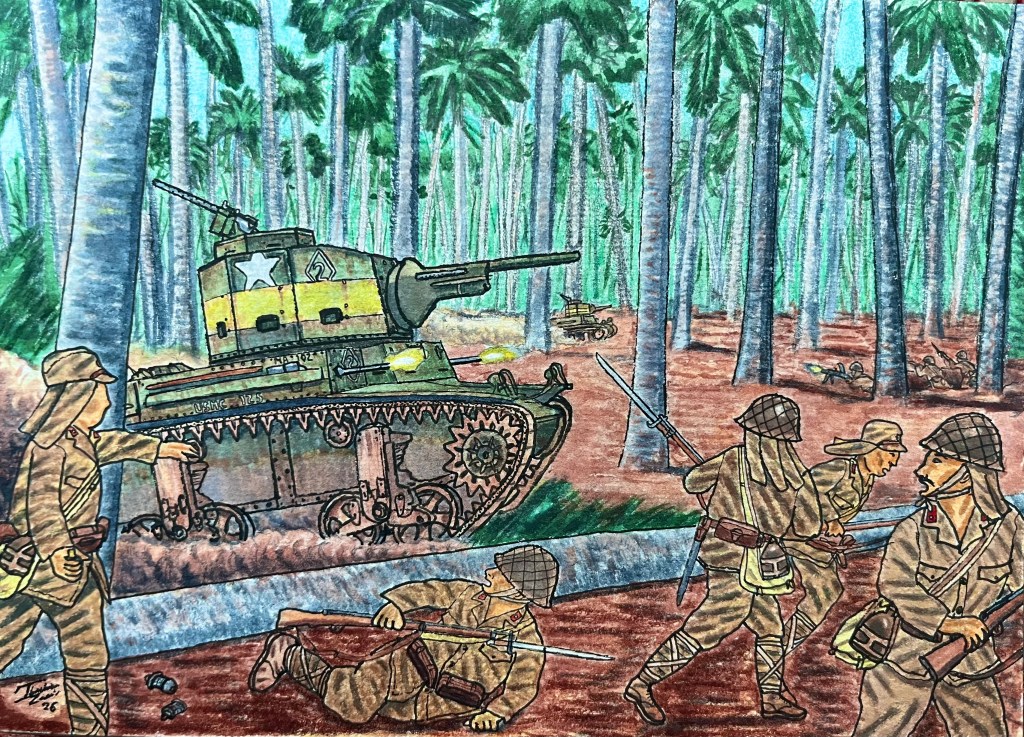
As morning turned to afternoon, Ichiki’s men were increasingly confined to a coconut grove east of Alligator Creek. Hoping to end the battle before the survivors could escape, the Americans deployed five M2A4 tanks from Company A, 1st Light Tank Battalion across the sandbar at 15.00hrs.
This scene shows the tanks as they rumble through the coconut grove, where the Ichiki Detachment made its last stand. The M2A4 was first built in May 1940 as a replacement for the underpowered M2 light tank. Armed with a 37mm gun and five .30cal machine guns, the M2A4 was well-suited for supporting infantry but its thin armour was vulnerable to anti-tank weapons. Coconut palm plantations covered the area around Henderson Field and typically lacked underbrush, which limited concealment. However, this did not stop the Japanese from fighting back with grenades and magnetic charges inside the grove.
The Ichiki Detachment was virtually destroyed, but had fought tenaciously until the end; fifteen Japanese prisoners were taken, only two of whom were not wounded. Colonel Ichiki, who had underestimated the Marine defenders, may have charged into the fight or committed suicide. Either way, the ‘Battle of the Tenaru’ was a shock to Japanese high command, prompting them to send additional troops in what would become a prolonged six-month struggle for the island and its airfield.
Sources
Bogdanovic, Nikolai. World War II: Battle by battle. Oxford, England: Osprey Publishing, 2019
Mueller, Joseph. Guadalcanal 1942: The Marines Strike Back. Oxford, England: Osprey Publishing, 1992.
National WWII Museum, ‘The Solomon Islands Campaign: Guadalcanal’, no date (https://www.nationalww2museum.org/war/articles/solomon-islands-campaign-guadalcanal, accessed 28th Aug 2026).
Rottman, Gordon. US Marine vs Japanese Infantryman: Guadalcanal 1942-43. Oxford, England: Osprey Publishing, 2014.
Stille, Mark. Guadalcanal 1942-43: America’s first victory on the road to Tokyo. Oxford, England: Osprey Publishing, 2015.
By Ibrahim Zamir


2 thoughts on “Last stand at Guadalcanal, 21st August 1942”