For chronological order, click here to see the previous WW2 post!
Undeterred by its losses in the Coral Sea, the Imperial Japanese Navy (IJN) prepared to invade Midway Atoll- 1,300 miles northwest of Hawaii – in a final effort to defeat the US Pacific Fleet. Committing their largest naval operation of the war, the Japanese were unaware that the Americans had already decoded their messages and had lost the element of surprise.
In the early hours of 4th June, the 1st Mobile Force (made up of four aircraft carriers) launched its planes at Midway. While preparing for a second strike, the Japanese became aware that American carriers were nearby. The battle then took a drastic turn; from 10.22hrs, dive-bombers from USS Enterprise and Yorktown caused severe damage on three Japanese carriers, forcing them to be abandoned. Only one – the Hiryu – was left undamaged and able to launch a counterattack.
Just before midday, Yorktown‘s radar detected 18 D3A1 ‘Val’ dive-bombers and six escorting ‘Zero’ fighters, commanded by Lt. Michio Kobayashi. The Val was the standard Japanese carrier-based bomber at the start of the war, carrying one 550lb bomb as well as additional 132lb bombs under each wing – a light payload compared to the American SBD Dauntless. The Val also lacked armour, but was an accurate dive-bomber in the right hands.
About 15-20 miles out, the Vals were attacked by F4F Wildcats and lost ten planes, including Kobayashi’s. Yorktown and its escorting ships then opened up with intense anti-aircraft (AA) fire which caused further losses. As the lead ship of its class, the carrier received a heavy AA armament which included the new 5in./38 dual-purpose gun – the best long range AA weapon of the war.
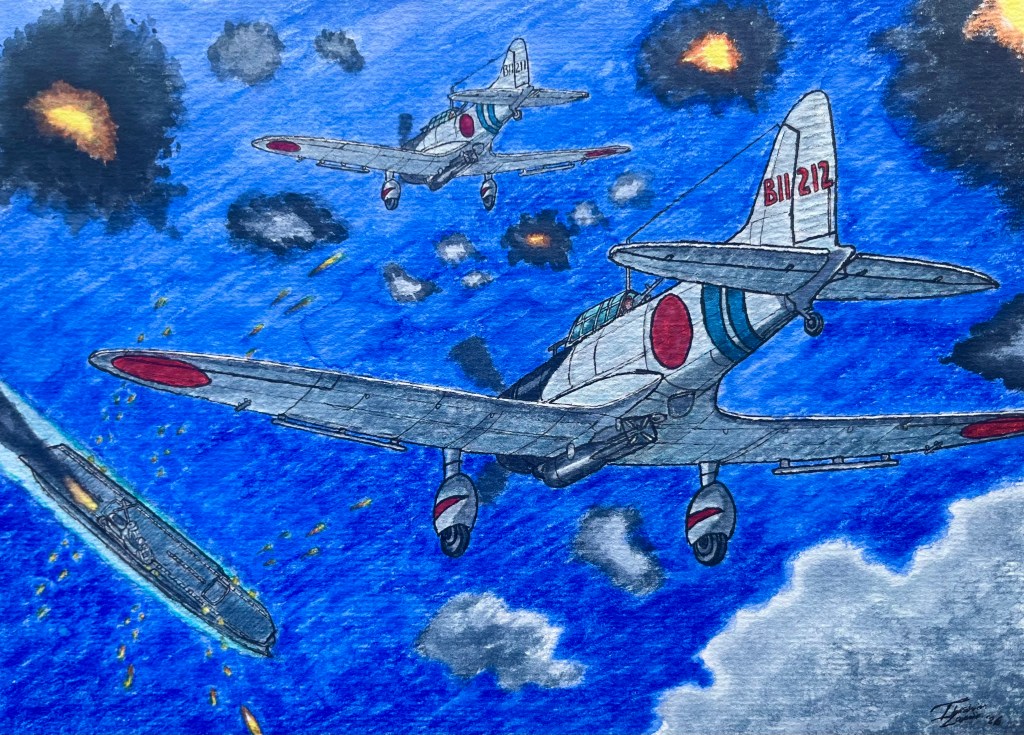
In this scene, the Vals are diving towards Yorktown. The first hit has already been scored, causing a fire abaft the No.2 elevator on the starboard side. The markings on the aircraft – two blue bands on the fuselage and ‘BII’ on the tail – identify them as from Hiryu.
The Japanese scored an additional two hits, damaging five boilers and further penetrating the flight deck. However, Yorktown was far from finished; the carrier was able to recover and launch additional aircraft in time for a second Japanese attack. At 14.37hrs, ‘Kate’ torpedo-bombers scored two hits on the port side, jamming the ship’s rudder and causing a list. Yorktown‘s dive-bombers were forced to stay in the air; at 17.05hrs, they joined aircraft from Enterprise and attacked Hiryu.
The following day, Yorktown had lost all power but was still afloat. Salvage efforts were now fully underway as the carrier was towed to safety by the minesweeper Vireo and escorted by six destroyers. The final blow came from the Japanese submarine I-168, which moved in undetected and hit the carrier with two torpedoes. These strikes effectively sealed Yorktown‘s fate; with no hope of recovery, the carrier finally sank in the early hours of 7th June.
Yorktown was a major loss for the US Pacific Fleet, but for the IJN the Battle of Midway was a disaster from which it would never fully recover. Having lost four fleet carriers, the balance of power in the Pacific had been decisively reversed in America’s favour.
Click here to see the next WW2 post in chronological order!
Sources
Bogdanovic, Nikolai. World War II: Battle by battle. Oxford, England: Osprey Publishing, 2019
Healy, Mark. Midway 1942: Turning Point in the Pacific. Oxford, England; Osprey Publishing, 1993.
National WWII Museum, ‘The Battle of Midway’, June 4th 2026 (https://www.nationalww2museum.org/war/articles/battle-midway, accessed 15th June 2026).
Naval History and Heritage Command, ‘USS Yorktown (CV-5) Action Report’, 18th June 1942 (https://www.history.navy.mil/content/history/nhhc/research/archives/digital-exhibits-highlights/action-reports/wwii-battle-of-midway/uss-yorktown-action-report.html, accessed 15th June 2026).
Naval History and Heritage Command, ‘USS Yorktown (CV-5)’, 20th June 2024 (https://www.history.navy.mil/browse-by-topic/ships/aircraft-carriers/uss-yorktown.html, accessed 15th June 2026).
Stille, Mark. Imperial Japanese Navy Aircraft Carriers 1921-45. Oxford, England: Osprey Publishing, 2005.
Stille, Mark. The Coral Sea 1942: The first carrier battle. Oxford, England: Osprey Publishing, 2009.
By Ibrahim Zamir


One thought on “The end of Yorktown, 4th June 1942”