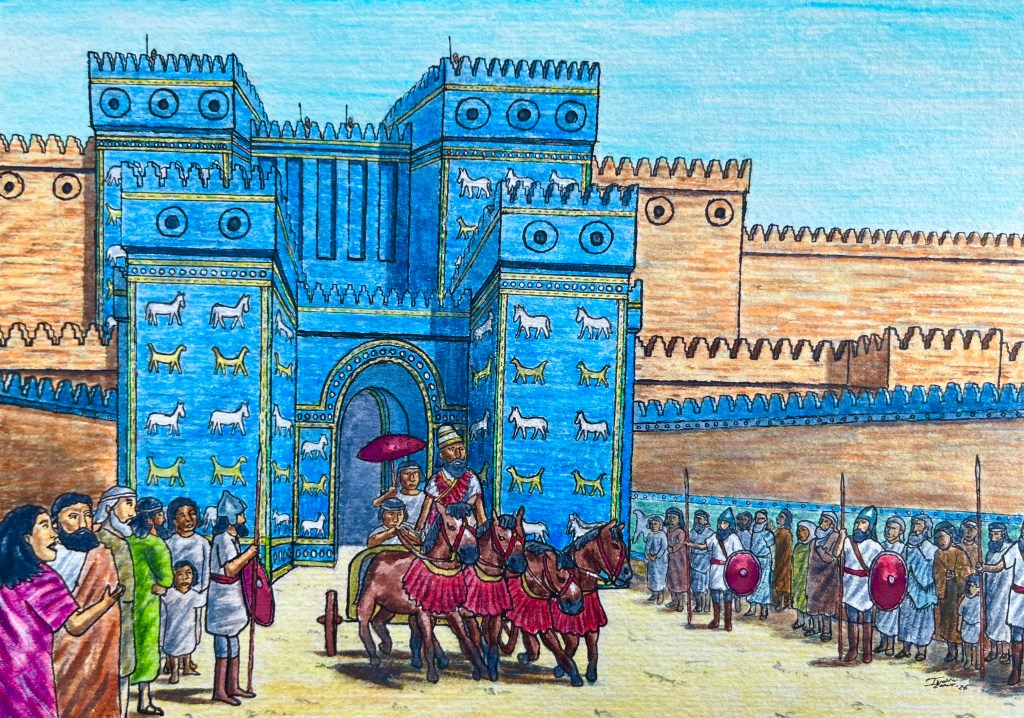
Built during the reign of King Nebuchadnezzar II (604-562 BC), the Ishtar Gate was one of the most important entrances to the city of Babylon (Iraq). Along with the Hanging Gardens, the gate became an iconic symbol of imperial prestige and ancient craftsmanship.
Due to a lack of stone in southern Mesopotamia, the two sections of the gate were made up of glazed bricks. These were decorated with reliefs of auroch bulls and mushussu dragons from Babylonian mythology. The gate itself formed part of the Processional Way, a decorated avenue that linked the inner city to the House of the New Year’s Festival (Bit Akitu). Here we see Nebuchadnezzar II, mounted on a chariot, as he passes through the Processional Way.
After Babylon fell to the Achaemenid Persians in 539 BC, the Ishtar Gate was left to collapse over time. Between 1899-1917, German excavations uncovered its deep foundations and numerous brick fragments. These were re-assembled into bricks and animal reliefs, then combined with modern materials to form a reconstruction at the Pergamon Museum.
Sources
Fitzgerald, Clare (2019), ‘A Wonder to Behold: Craftsmanship and the Creation of Babylon’s Ishtar Gate’. Institute for the Study of the Ancient World newsletter 25 (https://isaw.nyu.edu/publications/newsletters/025/ishtar, accessed 28th May 2026).
Garcia, Brittany, ‘Ishtar Gate’, 22nd August 2013 (https://www.worldhistory.org/Ishtar_Gate/, accessed 28th May 2026).
Metropolitan Museum of Art, ‘Panel with striding lion’, no date (https://www.metmuseum.org/art/collection/search/322586, accessed 28th May 2026).
Staatliche Museen zu Berlin, ‘From Fragment to Monument: The Ishtar Gate in Berlin’, 10th Nov 2020 (https://www.smb.museum/en/exhibitions/detail/from-fragment-to-monument/, accessed 28th May 2026).
By Ibrahim Zamir

