In May 1942, the Imperial Japanese Navy (IJN) prepared to capture Port Moresby on New Guinea. Its airfield could be used to dominate the Coral Sea and isolate Australia from the United States. The invasion force – spearheaded by aircraft carriers Shokaku and Zuikaku – was unaware that the Americans had cracked their codes and deployed the carriers USS Lexington and Yorktown to find them.
At 10.40 hrs on 7th May, aircraft from Lexington spotted the brand-new Japanese light carrier Shoho (‘Happy Phoenix’). Formerly a submarine tender, her conversion into a carrier took one year and was finished in January 1942. The ship was tasked with escorting the invasion fleet and providing air support. However, due to shortages she carried only 18 planes out of a capacity of 30. With no armour, her defence consisted of a light anti-aircraft (AA) armament and three fighter planes on patrol.
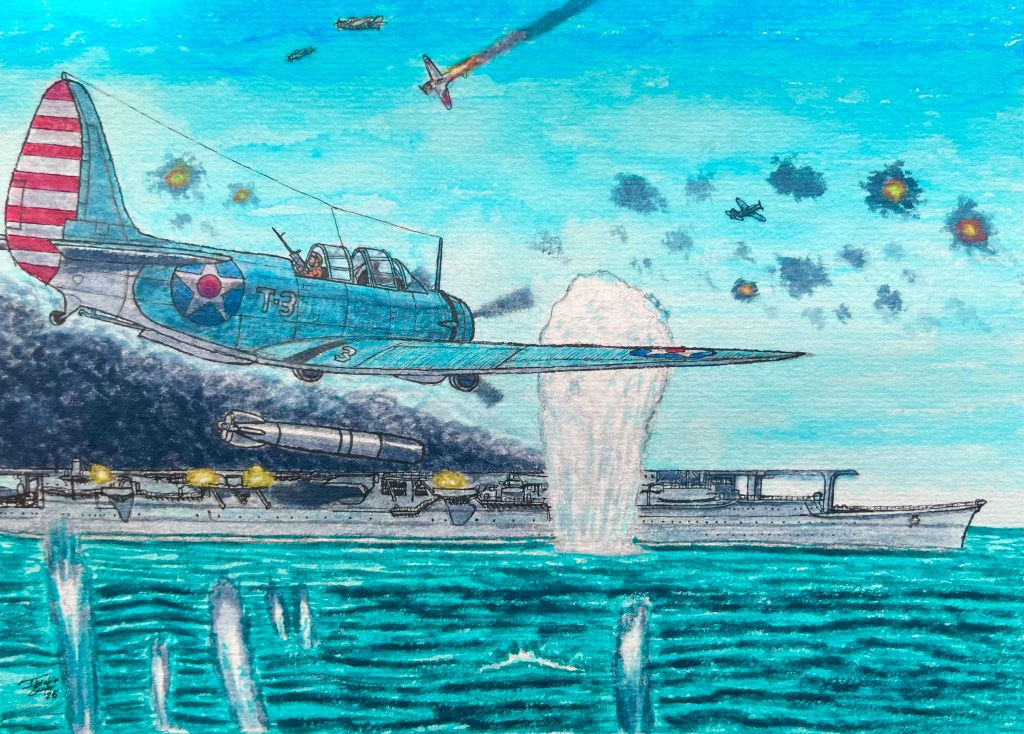
Lexington‘s dive-bombers attacked at 11.10hrs. Shoho was able to dodge the first 13 strikes, but could not avoid two 1,000-pound bombs that set her hangar deck on fire. At the same time, Douglas TBD Devastators from Torpedo Squadron 2 (VT-2) began descending from 4,000ft to 100ft.
Here we see a Devastator releasing its torpedo towards the burning carrier. The TBD was introduced in 1937 and was the US Navy’s first carrier-based monoplane. However, its slow speed and short range made the aircraft obsolete by 1942. The TBD could carry 1,000-pound bombs or the unreliable Mark 13 torpedo, which had to be dropped below 100mph and below 120 feet. This left the TBD even more vulnerable to enemy fighter planes and AA fire.
The 12 planes of VT-2 attacked Shoho from both sides, dropping their first torpedo at 11.19hrs. A total of five hits were scored, damaging the ship’s steering and causing uncontrollable flooding. Yorktown‘s air group followed up with further hits that caused the carrier to sink at 11.35hrs. Only 203 crew members survived out of a total of 834.
Shoho was the first Japanese carrier loss of the war, leading to a delay in the Port Moresby invasion until the American carriers could be confronted. The ensuing battle between the carriers – the first of its kind in history – was costly for both sides, but kept Port Moresby in Allied hands and reduced the IJN’s strength in numbers.
Sources
Lundstrom, John (2006), ‘Sinking of the Shoho’. Naval History 2, vol. 20 (https://www.usni.org/magazines/naval-history-magazine/2006/april/sinking-shoho, accessed 11th May 2026).
Parshall, Jonathan, ‘The Battle of Coral Sea: A retrospective’, 30 May 2022 (https://www.nationalww2museum.org/war/articles/battle-coral-sea-retrospective, accessed 11th May 2026).
Polmar, Norman, (2001), ‘The TBD Devastator: The good and the bad’. Naval History 1, vol. 15 (https://www.usni.org/magazines/naval-history-magazine/2001/february/tbd-devastator-good-and-bad, accessed 11th May 2026).
Stille, Mark. Imperial Japanese Navy Aircraft Carriers 1921-45. Oxford, England: Osprey Publishing, 2005.
Stille, Mark. The Coral Sea 1942: The first carrier battle. Oxford, England: Osprey Publishing, 2009.
By Ibrahim Zamir

