For chronological order, click here to see the previous WW2 post!
In late-1941, Malaya and Singapore hosted several airbases and an important naval base which allowed the British to strategically dominate the Far East. Despite a lack of reinforcements, it was assumed that these positions could be defended. But British planning failed to fully account for the rise of Japan, which was prepared to expand into the region in an effort to acquire more natural resources. Once Japanese troops occupied southern Indochina in July 1941, the threat of an all-out attack was raised even further.
On 2nd December, ‘Force Z’ arrived in Singapore to reinforce the defences and deter Japanese aggression. Commanded by Admiral Tom Phillips, it consisted of two capital ships (HMS Prince of Wales and Repulse) and four destroyers.
Small and unbalanced, Force Z failed to deter the invasion of Malaya on 8th Dec. With no air support and limited understanding of Japanese bomber range, Phillips decided to launch a fast strike on the Kota Bharu landing site in northeast Malaya. On 9th Dec, Force Z was spotted by Japanese planes, forcing Phillips to discard his plan and head back south. But after receiving a report of a Japanese landing at Kuantan – hundreds of miles away from the nearest IJN airbase – Phillips moved to investigate.
By the time his ships arrived off Kuantan the next day, a strike force of 85 land-based bombers from Genzan, Kanoya, and Mihoro Air Groups had been deployed to find Force Z. Once the capital ships were spotted by a scout plane, the Japanese attacks began at 11.15 hrs.
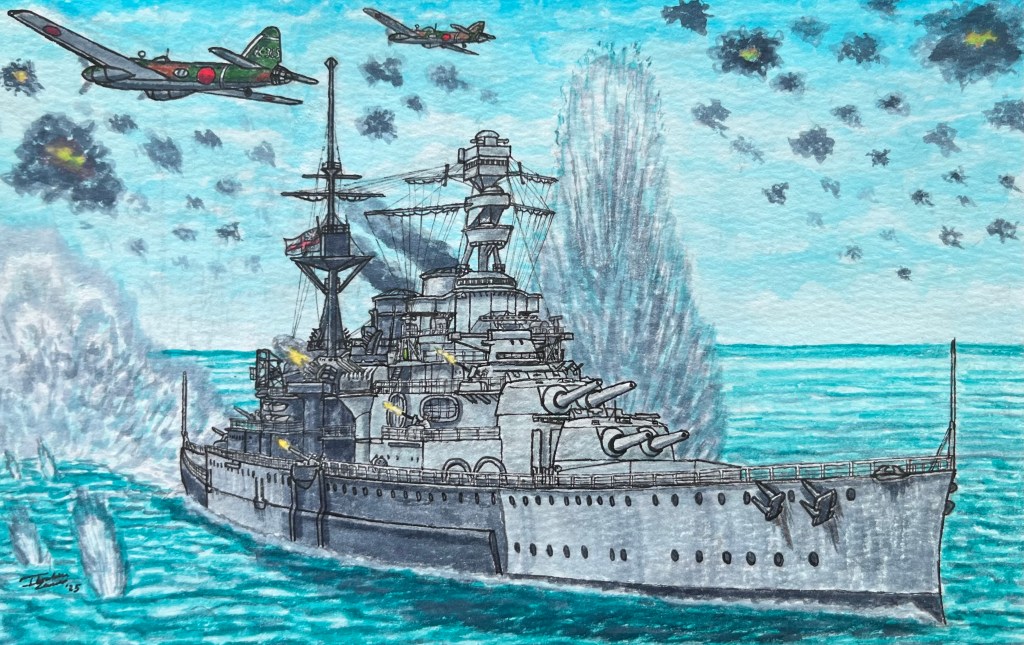
Repulse was the first target for the bombers. Completed in 1916, the battlecruiser was fast but lacked strong armour. She carried a main armament of six 15 in. guns and nine 4 in. Mk IX guns in triple mounts. By late-1941, her anti-aircraft (AA) defences had been expanded to include six 4 in. Mk V guns in single mounts, twenty-four 2-pdr ‘pom-poms’ in eight-barrel mounts, eight single 20mm Oerlikon mounts, and sixteen 0.5 in. machine guns in four-barrel mounts. These were fairly effective against level bombers, damaging five out of eight Japanese planes from the first attack wave.
Repulse continued to perform well, taking only minor damage from high-level bombs and avoiding several torpedoes. But the final blow came at 12.20 hrs. Through intense AA fire, twenty G4M ‘Bettys’ from Kanoya Air Group overwhelmed Repulse and scored five torpedo hits. One of them is shown here, striking amidships on the port side. These strikes caused a rapid list to port before the battlecruiser finally sank at 12.33 hrs – the first time a capital ship was defeated solely by air power on open waters. The battleship Prince of Wales met the same fate at 13.20 hrs. Survivors from both ships were picked up by the accompanying destroyers.
The destruction of Force Z was not only a major loss; the attack also marked the end of an era, as air power became the predominant force in naval warfare. For the loss of three planes and 21 airmen, the Japanese had ensured that Malaya and Singapore were isolated at sea and increasingly under pressure on land.
Click here to see the next WW2 event in chronological order!
Sources
Bogdanovic, Nikolai. World War II: Battle by battle. Oxford, England: Osprey Publishing, 2019.
History of Diving Museum, ‘Sinking of the HMS Repulse’, no date (https://divingmuseum.org/indepth/repulse/, accessed 15th Dec 2025).
Konstam, Angus. Sinking Force Z: The day the Imperial Japanese Navy killed the battleship. Oxford, England: Osprey Publishing, 2021.
Stille, Mark. Malaya and Singapore 1941-42: The fall of Britain’s empire in the East. Oxford, England: Osprey Publishing, 2016.
Wong, Heng ‘HMS Repulse – Singapore Infopedia’, 24 Jan 2018 (https://www.nlb.gov.sg/main/article-detail?cmsuuid=c8a42fc5-4b92-4bfa-a94b-810430dc8056, accessed 15th Dec 2025).
By Ibrahim Zamir

