The colossal German battleship Tirpitz was a major threat to British sea routes in early-1942. If deployed in the Atlantic it would take refuge in the port of St Nazaire, where the Normandie Dock – the largest of its kind in the world – was big enough to accommodate it for repairs. If the dry dock were destroyed, the battleship would be less likely to move further without risking irreparable battle damage.
The attack plan (‘Operation Chariot’) centred on using a destroyer to ram the gate of the dry dock, while specially-trained Army Commandos would demolish dockyard facilities and silence enemy guns. HMS Campbeltown was selected for the mission; launched in 1919 as the USS Buchanan, the obsolete destroyer was transferred to the Royal Navy in Sept 1940 in exchange for American access to British naval bases. She was specially modified for the operation; to disguise the ship as a German Möwe class destroyer, the two front funnels were cut at an angle and the forward funnel was enlarged. The bridge and deck were refitted with armour plating and splinter mats. The destroyer also received new weapons – a forward 12-pdr gun and eight 20mm Oerlikon cannons – and was stripped of non-essential items to reduce weight.
After midnight on 28th March Campbeltown, accompanied by 18 smaller vessels, quietly sailed up the mouth of the Loire River before taking intense fire from German gun batteries. Tearing through an anti-torpedo net, the destroyer rammed the southern caisson of the Normandie Dock at 01.34hrs.
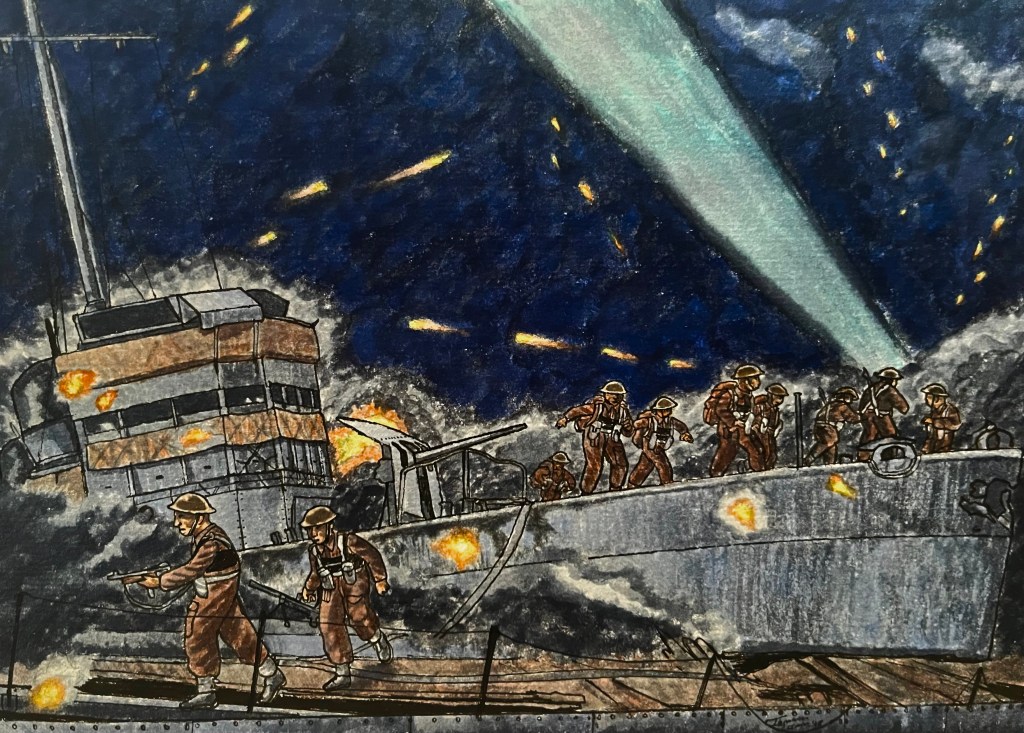
Within minutes, the Commandos aboard Campbeltown rushed over the sides and onto the gate. Immobile and with her bow pointing upwards, the ship was an easy target for German guns and searchlights.
Here we see the view from the starboard side, where Lieutenant J Roderick’s assault team of 13 Commandos disembarked in order to knock out three gun positions and destroy underground fuel stores. No ladder is shown on this side of Campbeltown; according to an account from Roderick, the Commandos’ bamboo ladder was damaged before they left the ship, so they used a length of cable to get onto the gate. Although the German guns were eliminated, Roderick’s team could not set the fuel stores on fire and lost four men. Afterwards they set up a flank guard on the western side of the dry dock and waited to withdraw.
By dawn, almost all the raiding force of 611 men had been killed or captured. Most of the dockyard facilities had been demolished and Campbeltown remained stuck on the caisson, where it attracted hundreds of German troops and sightseers. But they failed to spot the ship’s final countermeasure – twenty four Mk VII depth charges, fitted to the forward compartment and now perfectly positioned against the caisson wall. They were primed to explode within eight hours, but the pencil fuses did not set off until 10.35hrs. The delayed explosion killed over 350 Germans and kept the Normandie Dock out of use for the rest of the war.
Sources
Ford, Ken. ‘St Nazaire 1942: The Great Commando Raid’. Oxford, England: Osprey Publishing, 2001.
National Army Museum, ‘The raid on St Nazaire, 28 March 1942’, no date (https://collection.nam.ac.uk/detail.php?acc=2003-02-357-1, accessed 5th April 2026).
National WWII Museum, ‘The British Raid on St Nazaire: Part II’, 30th April 2021 (https://www.nationalww2museum.org/war/articles/british-raid-st-nazaire-part-ii, accessed 5th April 2026).
Second World War Experience Centre, ‘Lieutenant John Roderick MC’, no date (https://war-experience.org/lives/lieutenant-john-roderick-mc/, accessed 5th April 2026).
St Nazaire Society, ‘The story of Operation Chariot’, no date (https://operation-chariot.org/thestoryoftheraid.html, accessed 5th April 2026).
By Ibrahim Zamir
 Empire of History