Japan’s conquest of the Dutch East Indies (modern Indonesia) depended heavily on securing the vast natural resources of the archipelago. Near Palembang, capital of South Sumatra, was an Allied airfield (‘P1′) as well as two oil refineries – Plaju and Sungei Gerong – which processed a third of the Indies’ oil production. If the refineries were captured intact, the Japanese could continue to supply their war effort and encircle the main island of Java.
At 11.26hrs, IJA paratroopers of the 2nd Raiding Regiment dropped over P1, then over the refineries four minutes later. At Plaju, 60 men from Lieutenant Nakao’s 1st Company landed mainly to the southwest, while some landed in the oil facility itself. As the paratroopers re-grouped and advanced, they placed flags on three distillation towers and started shutting down refinery equipment to prevent damage.
Each facility was defended by a garrison of around 150 KNIL troops. In the early-afternoon, three reinforced platoons under Captain Ohl launched a counterattack at Plaju. Covered by mortars and machine gun fire, they were able to recapture most of the refinery after intense close-range fighting.
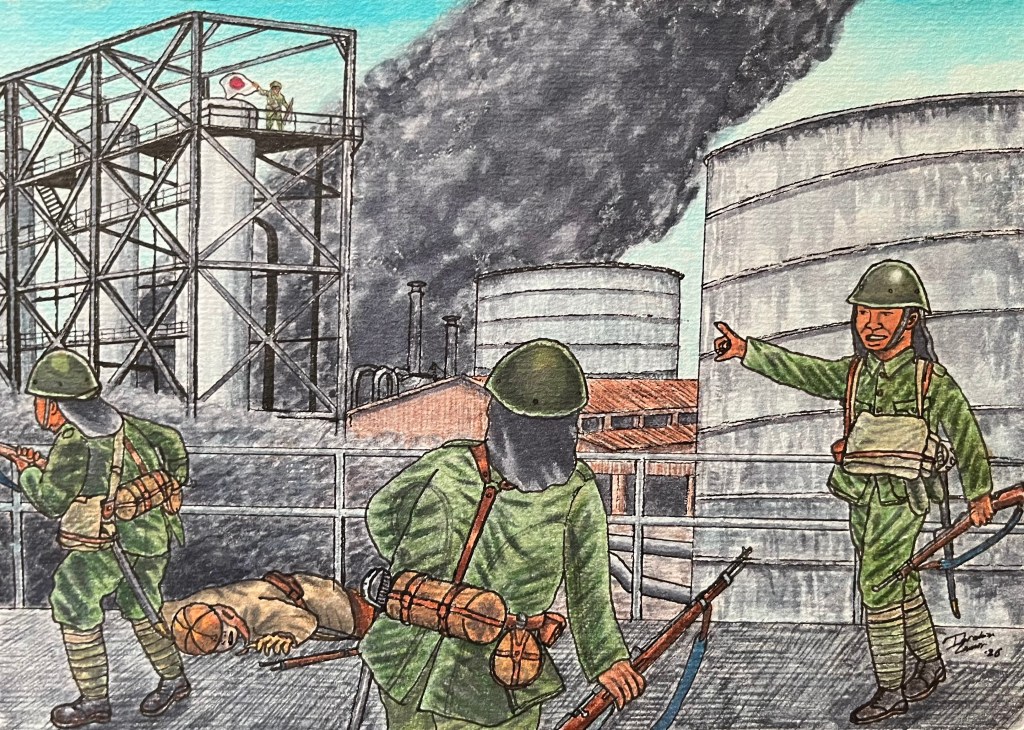
This scene shows Menadonese riflemen of 2nd Company, 10th Infantry Battalion as they spot a Japanese flag being removed from a tower; all three were lowered by Lieutenant Van Blommenstein, Private Buntua and Private 1st Class Pelealuw. In the background, oil tanks and pipes that were hit by bullets and mortar shells are covering the refinery with smoke.
The KNIL troops continued fighting into the night as they tried and failed to dislodge the last group of 15 paratroopers. As additional Japanese forces approached Palembang from the Musi River, the defenders began to withdraw.
The Japanese 229th Regiment captured the city on the night of 15th February, then made contact with the paratroopers the next day; out of 329 men who had jumped over the refineries, 39 were killed and 48 wounded. They had also lost Sungei Gerong to a delay-fused demolition charge that exploded at dawn on 15th Feb. But Plaju and its large oil stocks had been successfully captured with little damage. This major victory paved the way for a full Japanese conquest of South Sumatra and encirclement of Java.
Sources
Lohnstein, Marc. Royal Netherlands East Indies Army 1936-42. Oxford, England: Osprey Publishing, 2018.
Lohnstein, Marc. The Netherlands East Indies Campaign 1941-42: Japan’s Quest for Oil. Oxford, England: Osprey Publishing, 2021.
Remmelink, Willem (ed.), The Invasion of the Dutch East Indies. Leiden University Press, 2015.
Rottman, Gordon and Takizawa, Akira. Japanese Paratroop Forces of World War II. Oxford, England: Osprey Publishing, 2005.
By Ibrahim Zamir
 Empire of History